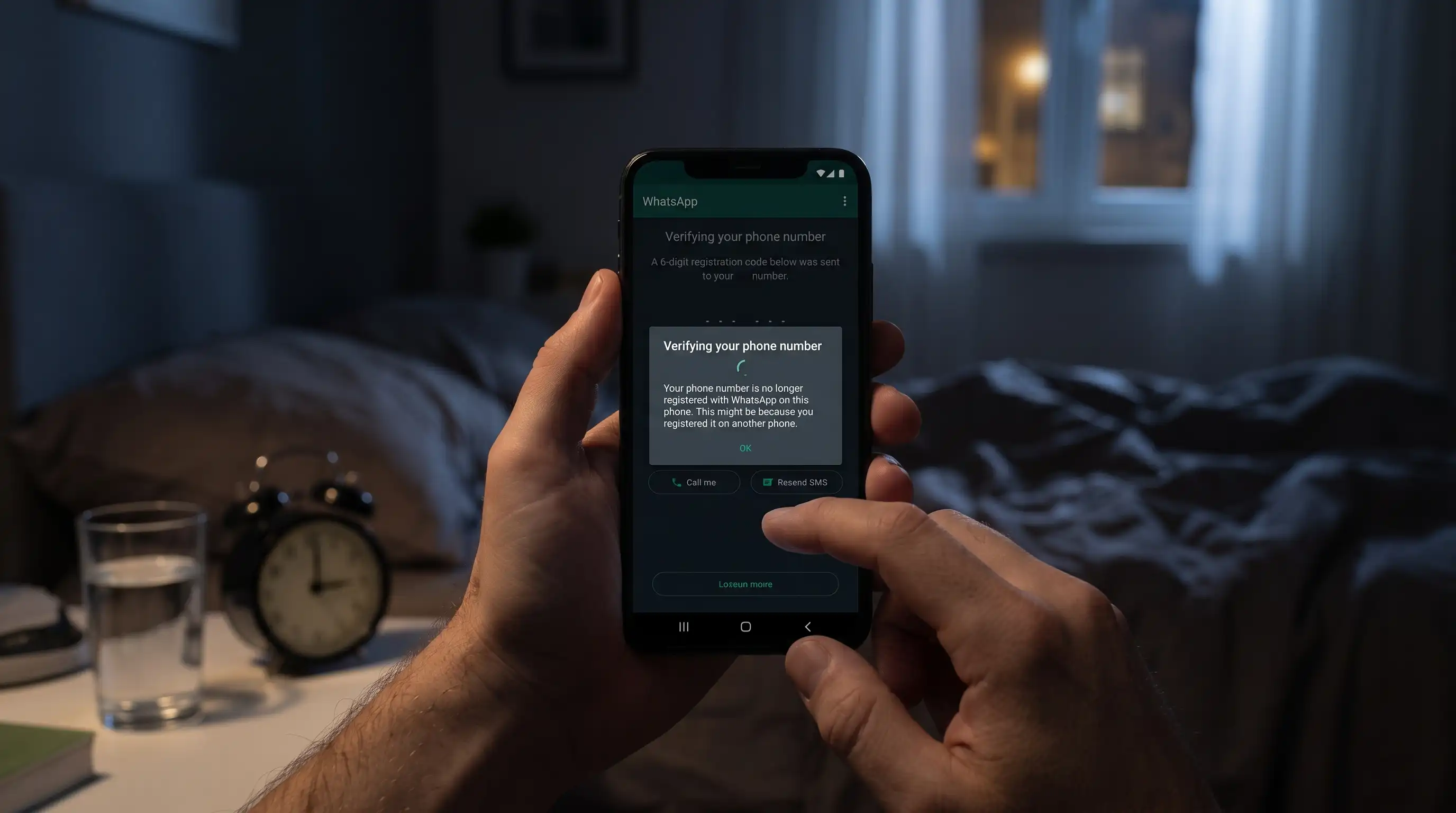
You go to sleep peacefully. Your phone is resting on the nightstand, charging, completely untouched. The next morning, you wake up, open WhatsApp, and are greeted by a terrifying message: "Your phone number is no longer registered on this phone."
During the night, cybercriminals hijacked your account. They didn't use undetectable spyware, nor did they hack Meta's servers. They exploited a vulnerability in a service you probably forgot even existed: your voicemail. As security specialists, we will explain the anatomy of this attack and how to slam the door on these attackers today.
1. Anatomy of the Attack: The 3 A.M. Factor
To register a WhatsApp account on a new phone, the app sends a 6-digit verification code via SMS to the owner's number. If the SMS fails or is delayed, WhatsApp offers a second option: "Call Me".
This is where the attacker's choreography begins. The cybercriminal installs WhatsApp on their own device and enters your phone number at around 3:00 a.m. or 4:00 a.m., knowing you will be fast asleep.
| Attacker's Step | What Actually Happens |
|---|---|
| 1. Code Request | The attacker requests the code. WhatsApp sends you an SMS that you ignore because you're sleeping. |
| 2. "Call Me" Activation | The attacker waits for the SMS timer to expire and presses the button to have WhatsApp call you. |
| 3. Voicemail Takes Over | Your phone rings in the dead of night. Since you don't answer, WhatsApp's automated system leaves the 6-digit code on your voicemail. |
2. The Fatal Flaw: The Default PIN
At this point, the code is safely tucked away in your voicemail, right? Wrong. The vast majority of telecom carriers allow users to listen to their voicemail remotely from another phone by calling a remote access number and entering a security PIN.
The architectural flaw is that almost nobody sets up that PIN. Users leave the default passwords assigned by their carriers, which are incredibly predictable: 0000, 1234, 1111, or the last 4 digits of their own phone number.
The hacker simply calls your voicemail from their device, guesses the generic PIN on the first try, listens to the WhatsApp recording with the 6 digits, enters them on their screen, and boom! They hijack your account, kick you out of your session, and start requesting urgent money transfers from all your family and work contacts.
3. The Defense Plan: How to Bulletproof Your Account
Slamming the door on this type of identity theft is quick and doesn't require advanced technical skills. There are two layers of security you must implement immediately.
🛡️ Rapid Action Protocol:
- Change your voicemail PIN (or disable it): Call your carrier's voicemail service. Enter the security settings and change the password to a 4 or 6-digit number that only you know. If you honestly never use voicemail, call your telecom provider's customer service and ask them to disable the feature entirely.
- Enable Two-Step Verification (2FA) on WhatsApp: This is your ultimate barrier. Go to Settings > Account > Two-step verification inside WhatsApp and create a PIN. This way, even if the hacker manages to listen to your voicemail, the app will demand this second PIN that only exists in your brain.
🤖 Spot scams before you fall for them
If you get a strange message from a friend in the middle of the night asking for money due to an "emergency" or "because their card was blocked", it's highly likely their account was hijacked using the voicemail trick. Before making any transfers, copy the message and paste it into our AI Message Checker to analyze its patterns and confirm if you are talking to a scammer.